Management Innovations symbol

MANAGEMENT INNOVATIONS

Vision to Implementation

NFR Leadership Portal

Stop managing by reminder.

NFR helps leaders replace chasing with clear commitments, visible execution, early escalation, and earned trust.

Executive view

Use this portal to build a common NFR language, diagnose follow-up drag, redesign operating agreements, and install leadership disciplines that hold under pressure.

Leadership thesis

Follow-up is the symptom of broken execution design.

When leaders repeatedly chase updates, approvals, inputs, or decisions, time moves away from strategy, coaching, and execution leadership. The cost is not only delay. It is lost focus, lower trust, and slower organizational learning.

NFR does not ask people to communicate more. It asks them to communicate earlier, more clearly, and with enough visibility that routine reminders stop being part of normal work.

Clear commitments
Visible execution
Early risk signals

Operating shift

From chasing to trusted flow

Reminder-driven

Work advances only after checking.

Unclear expectations, late risk signals, duplicated trackers, and repeated status-chasing become normal.

ChasingBuffersDefensive coordination

NFR-driven

Work advances through clarity and trust.

Commitments are explicit, visibility is shared, and risks surface early enough for intelligent response.

AgreementsVisibilityEarly escalation

One Trusted Source of Truth

Shared updates before deadlines, consistent visibility, and trusted trackers reduce status-chasing and build confidence in execution.

Shared commitments stay visible before anyone has to ask.
A defined update rhythm lowers uncertainty and emotional vigilance.
Escalation happens while options still exist, not after deadlines fail.

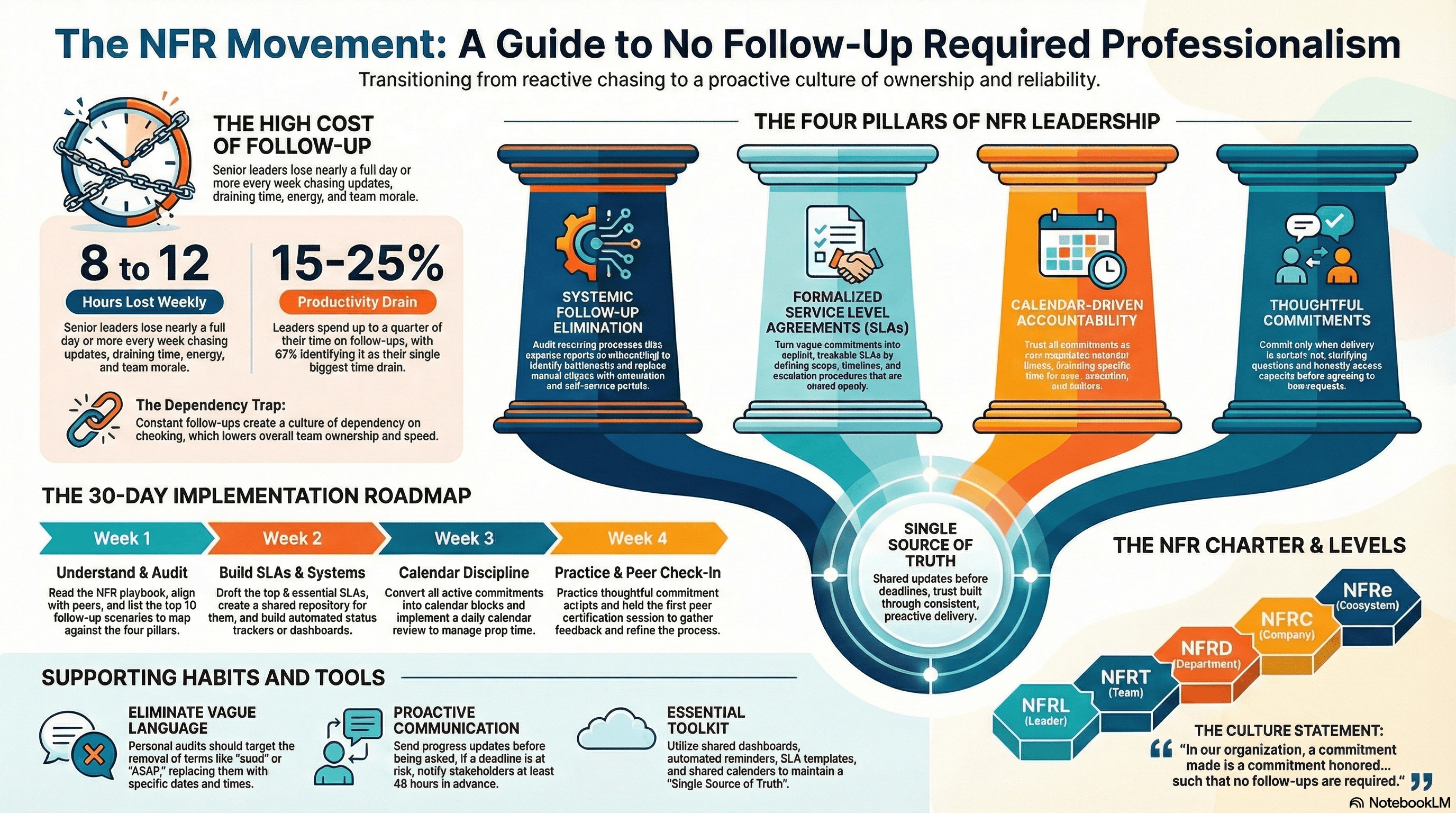
Hours lost weekly

8 to 12

Senior leaders can lose nearly a full day every week chasing updates, clarifying missed commitments, and extracting basic status.

Productivity drain

15 to 25%

Follow-up consumes leadership energy directly and also slows the wider organization through dependence, waiting, and repeated rework.

Trust damage

Dependency trap

Constant checking teaches people that reminders are part of normal work, which lowers ownership, trust, pace, and initiative.

What follow-up really damages

The cost spreads far beyond time.

The portal should make the hidden burden visible enough that leaders stop treating reminder culture as normal.

Cost 1

Leadership time is consumed by extraction rather than strategy, coaching, and value creation.

Cost 2

Emotional energy is drained by vigilance, irritation, and repeated re-engagement with the same unresolved issues.

Cost 3

Trust falls because people stop believing that commitments will move without checking.

Cost 4

Team morale weakens when responsible people carry the load of chasing others just to keep work moving.

Cost 5

Execution speed slows because work advances through reminders instead of through self-propelling reliability.

Cost 6

A survival mindset spreads as people create buffers, copies, private trackers, and defensive behaviors to protect themselves.

How to use this portal

One system. Three entry paths.

Different users enter for different reasons, but all of them need a clear route from insight to disciplined execution.

Implementation logic

01

See the drag

Make the cost of follow-up visible in time, trust, morale, and pace.

02

Map the loop

Use the workbook to identify who you chase, who chases you, and where dependence is most expensive.

03

Redesign the relationship

Install clearer SLAs, stronger promises, visible trackers, and earlier escalation rules.

04

Prove reliability

Demonstrate that reminders fall, trust rises, and the operating loop becomes more self-propelling.

Field scenes

What reminder culture looks like in a real day.

These image-led story frames lighten the reading load while making the human reality of follow-up visible.

8:00 AM

The day starts in rescue mode

When every square on the calendar says urgent, leadership time stops being strategic.

Inspired by the overloaded-calendar scene you shared: the system is already sending distress signals before the day properly begins.

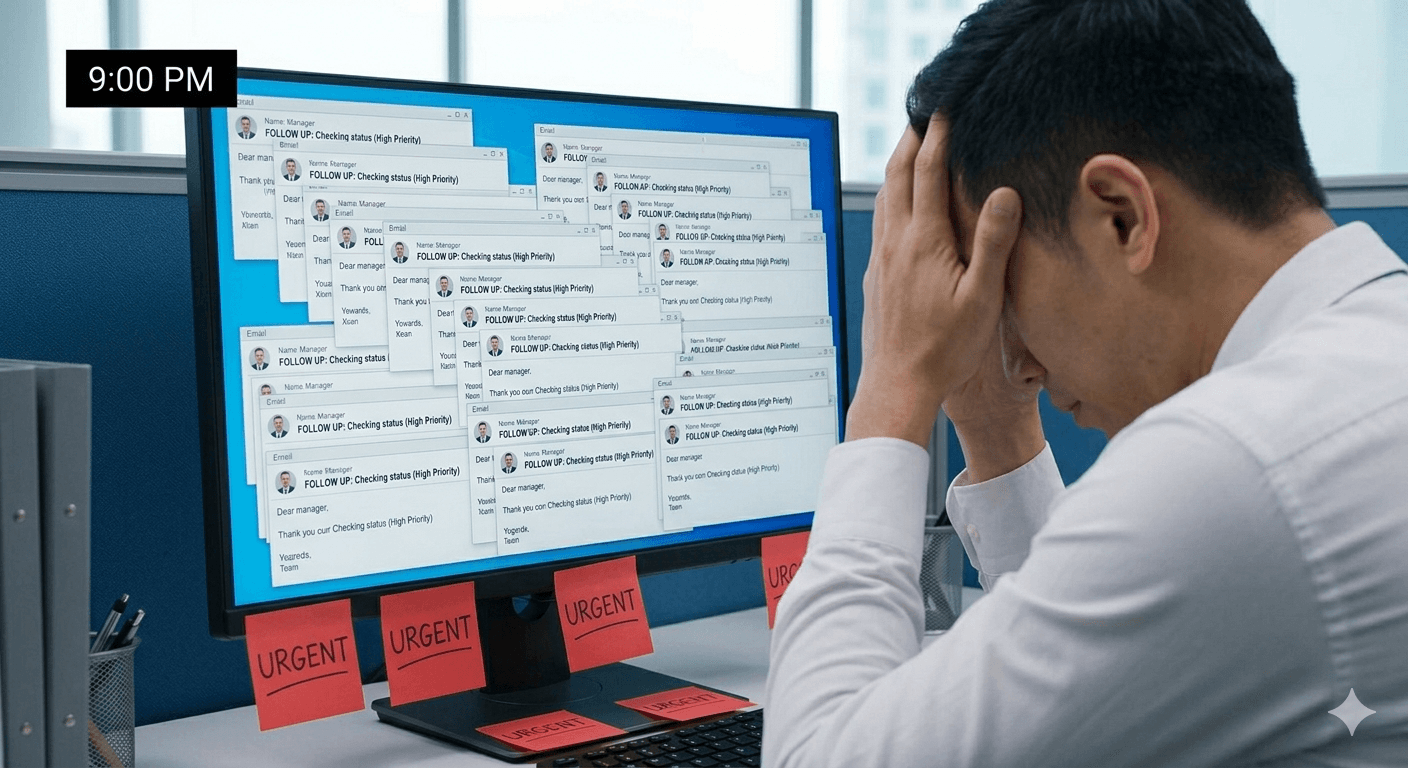
9:00 PM

Follow-up after hours

The workday ends, but the reminder culture keeps the mind at the office.

This is the hidden cost people rarely quantify: attention spillover, fatigue, and the emotional tax of unresolved follow-up.

4:30 PM

The blame circle

When ownership is unclear, the conversation becomes a pointing exercise.

A reminder-driven culture eventually turns from chasing work to chasing accountability.

Comic relief

Even serious portals need a little air.

A few visual jokes help people recognize the everyday absurdities of follow-up without making the subject feel trivial.

The ASAP trap

"ASAP" is not a date. It is tomorrow's follow-up.

Humor helps here because vague urgency is one of the oldest repeat offenders in management.

The CC storm

If seven people are copied, trust has probably left the room.

The email grows because confidence in direct ownership has already weakened.

The calendar miracle

A promise without time blocked is a motivational speech.

Calendar discipline looks boring until it saves an important commitment.

Executive lines

The ideas people should remember.

Short, repeatable lines give the portal more authority and help the NFR language travel into real management conversations.

Line 1

Follow-up is not the cost. It is the symptom of the cost.

Line 2

Reliability is not claimed. It is experienced.

Line 3

In our organization, a commitment made is a commitment honored. Leaders and teams operate with such clarity, ownership, and integrity that no follow-ups are required.

NFR architecture

The four NFR pillars

01

Remove Systemic Follow-Up

Audit recurring process drag, expose bottlenecks, and remove avoidable dependence through redesign, data flow, automation, and self-service visibility.

02

Formalize SLAs

Turn vague expectations into explicit service commitments with scope, format, timelines, escalation rules, and completion logic.

03

Lead from the Calendar

Treat serious commitments as protected time with preparation, execution, review, and buffers rather than as optimistic intentions.

04

Commit Thoughtfully

Commit only after clarifying scope, timing, dependencies, and capacity, then renegotiate early if risk emerges.

Implementation path

Install NFR in 30 days

Week 1

Implementation sprint

Audit the drag

Read the NFR playbook, align with peers, and map the top follow-up scenarios against the pillars and the real cost of follow-up.

Week 2

Implementation sprint

Build agreements and systems

Design the essential SLAs, promises, and visible systems that can reduce dependence and unnecessary reminders.

Week 3

Implementation sprint

Lead from the calendar

Convert commitments into real calendar architecture and establish a practical review rhythm before deadlines break.

Week 4

Implementation sprint

Run and review

Run the first implementation cycle, gather stakeholder feedback, and refine the NFR system with check-ins and peer review.

NFR horizon

From leader to enterprise

The NFR movement grows from individual leadership behavior into team norms, departmental service quality, company culture, and ecosystem trust.

NFRL

Leader

A leader whose commitments and communication are dependable enough that key stakeholders do not need to follow up for basic reliability.

NFRT

Team

A team that works through explicit internal commitments, peer accountability, and visible execution instead of reminder-driven coordination.

NFRD

Department

A department that serves other functions through clear SLAs, visible tracking, and dependable escalation, reducing cross-functional drag.

NFRC

Company

An organization whose norms, dashboards, calendars, and accountability practices make no-follow-up-required professionalism a cultural standard.

NFRE

Ecosystem

The extended network of partners, vendors, collaborators, and customers where reliability expectations travel beyond the company boundary.

Cultural standard

Make commitments credible

In our organization, a commitment made is a commitment honored. Leaders and teams operate with such clarity, ownership, and integrity that no follow-ups are required.
NFRL standard: NFRL is awarded when a leader demonstrates enough clarity, proactive communication, and reliability that routine follow-up visibly declines for the people who depend on them.

Drop vague language

Remove terms like 'soon' and 'ASAP' and replace them with explicit dates, times, and completion logic.

Communicate early

Share progress and risk before people ask. If a deadline is at risk, notify stakeholders at least 48 hours in advance.

Use visible tools

Use shared dashboards, automated reminders, SLA templates, and visible calendars to maintain a trusted source of truth.